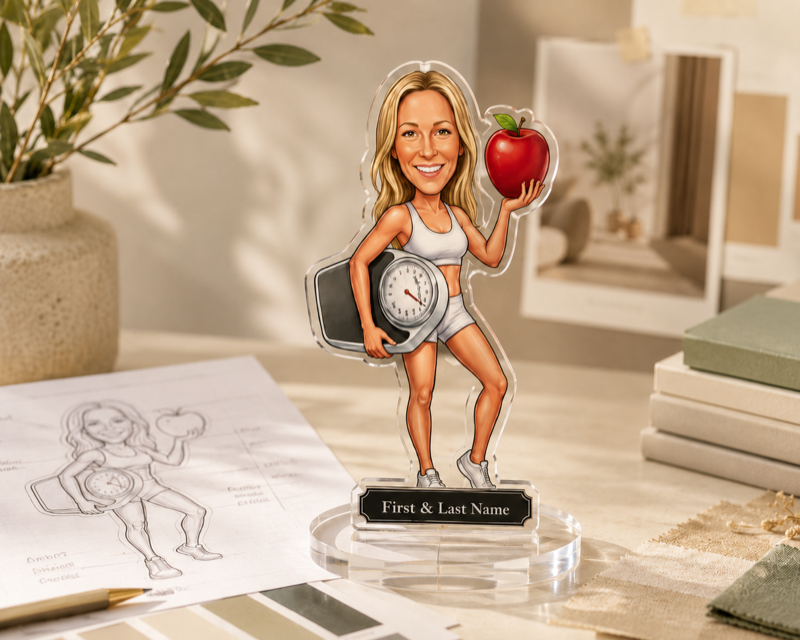
What makes a brief "custom"
A custom brief begins where the catalog ends. If the profession, pose, combination of details, or specific subject matter you need is not available in the standard catalog, a custom artwork is the path forward.
Custom does not necessarily mean starting from zero. If a catalog model is close but requires modification — a different tool, a specific emblem, a pose adjustment — we scope that as a custom modification rather than a full concept study. Full custom applies when the fundamental design of the figure needs to be resolved from the brief.
The custom brief conversation covers: the subject (who or what the figure represents), the intended message (what should someone feel receiving this piece), the specific details that make it uniquely this subject, and the production method and format.
Unique pose: communicating the specific
Pose is the most expressive decision in figurine design and the one that custom briefs most commonly need to resolve. The catalog offers the most universal poses for each profession — the pose that represents the profession most broadly. A custom brief can specify something much more particular.
A cardiologist reviewing a patient's echo. A chef in the middle of plating. A runner crossing a specific finish line. A couple at the exact moment of a first dance. These poses carry narrative that generic catalog poses cannot. The specificity of the moment is part of the tribute.
We present two or three pose concepts for each custom brief before committing to full artwork resolution.
Personal detail: what makes it unmistakably them
Personal detail is the element that converts a figurine from a representation of a profession into a representation of a specific person. It might be a distinctive feature that any colleague would recognize, a specific badge or decoration, the particular model of equipment they use, or a personal item that has significance beyond the professional context.
We ask during the brief: what are the three details that, if someone who knew this person saw them in the figure, they would immediately recognize? Those details receive the highest level of resolution in the concept study.
Nameplate design is handled as part of the brief — the font, format, and information to include. On a piece that will be displayed in a professional's office or kept by a family, the nameplate is often the first thing the viewer reads.
The approval and iteration process
Custom artwork proceeds through two structured review points before the piece goes to production. The first review presents the concept study: orthographic views of the resolved figure, the approved pose, and preliminary color treatment. This is the point at which structural changes can be made — proportions, pose adjustments, major detail decisions.
The second review presents the production-ready artwork: full color, complete detail, nameplate layout. This review is focused on final detail accuracy and color. Structural changes at this stage require brief re-opening and an additional iteration cycle.
We work from specific feedback rather than general impressions. "The stethoscope should be draped differently" is actionable. Clear, specific feedback is what drives the fastest path to a piece you will be proud to give.
From digital artwork to physical piece
Once the artwork is approved, it moves directly to production. For UV-printed acrylic and wood production through Grafizm's pipeline, the approval-to-production handoff is same-day. Standard production time is seven to ten business days.
The finished physical piece is what is kept — but the approved digital artwork is also a deliverable. Many clients use the high-resolution artwork file for digital cards, social announcements, or as a design asset in their own context.
Custom pieces representing significant milestones — retirements, decades of service, major achievements — are often paired with an accompanying message card or presentation box. These can be added to any custom order.