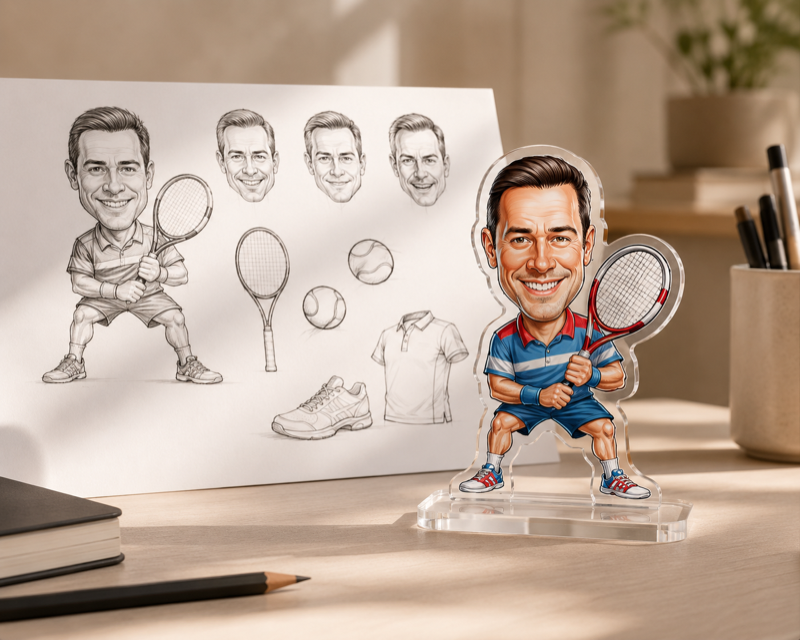
The brief: what we need to begin
The brief for a custom figurine concept study is more specific than most design briefs because the output is more specific. We need to know the subject — the profession, the characteristic elements that identify them, the intended setting of the finished piece.
Reference photographs are the most useful input. We work from photographs of the actual subject where available, and from representative references where not. The more specific the reference, the more specific the final artwork. A brief that says "a surgeon" produces a different result than one that says "a cardiovascular surgeon, female, mid-40s, preferred pose reviewing scans."
The brief conversation also covers the intended production method — UV-printed acrylic, wood, or a custom medium — because material properties affect certain detail decisions at the artwork stage.
Proportions and pose selection
Figurine proportions are not photographic. A life-accurate scale figure at 8 inches would have hands and facial features that disappear or appear as noise at production scale. Figurine design involves deliberate proportion decisions: slightly enlarged head-to-body ratio, simplified and clarified detail rather than accurate-but-illegible detail, hand and feature sizing calibrated to read at the finished scale.
Pose selection matters more than it might appear. A static standing pose communicates very differently from a pose in active use of the subject's specific tools or environment. We present two or three pose concepts for approval before finalizing the concept study.
The final proportions are drawn at production scale as well as at presentation scale, so that what you approve is what will be manufactured.
Detail layering and specificity
Detail layering in figurine design means establishing priority. Not every detail of the subject's appearance or environment can be reproduced at figurine scale — attempting to do so produces noise rather than legibility. We make explicit decisions about what reads at scale and what needs to be simplified or implied.
Professional-specific details are priority: the specific instrument, the identifying tool, the element that makes the subject unmistakably a member of their profession. These are resolved with the highest level of specificity. Supporting details — background elements, generic accessories — are simplified to support rather than compete.
A figurine that could be anyone is a product. A figurine that could only be this specific person is a tribute.
Material guidance and finish notes
The same artwork produces different results in different materials and print processes. A highly detailed illustration that reads beautifully in digital may require simplification for certain production methods where fine lines fill or are lost.
We provide explicit material guidance with each concept study: which elements are safe to reproduce in the intended medium, which require simplification, and what finish — matte, gloss, satin — best serves the overall piece.
For UV-printed acrylic, we note color gamut limits and areas where color accuracy may vary from the digital reference. For wood, we note how the material texture interacts with the print layer and whether tone adjustments are needed.
From artwork to physical production
The concept study is not a final print file — it is the design resolution document from which the production file is prepared. After concept approval, we prepare a production-optimized version: color profile conversion, resolution confirmation, bleed and crop mark placement, and any production-specific adjustments flagged in the material guidance.
For clients ordering directly through Grafizm's production pipeline, this handoff is seamless — concept study approval moves directly to production queue. Standard production time is seven to ten business days.
For clients providing the artwork to their own manufacturer, we deliver both the production-ready file and a specification document the manufacturer can use as a quality reference.