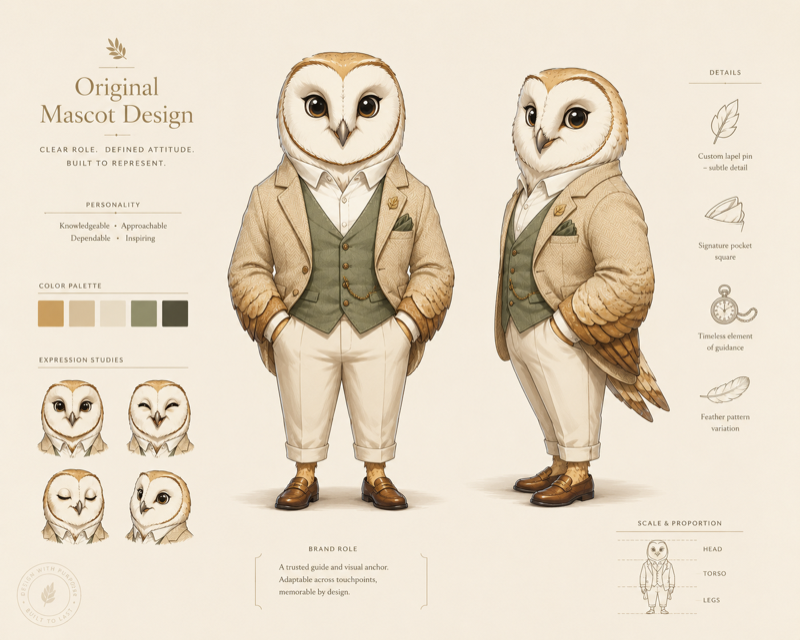
What makes a mascot work long-term
Most mascot designs fail at the same point: the character is designed for one application and then forced into others. Designed for a static logo, it looks awkward animated. Designed for full-color illustration, it fails as a single-color stamp. Designed with a fixed expression, it cannot communicate a range of brand emotions.
A mascot that works long-term is designed as a system: consistent anatomy that can be reproduced by different illustrators, a clear personality brief that guides expression and pose decisions, and a base design technically compatible with every medium in which it will appear.
At Grafizm, the mascot brief process explicitly addresses long-term use. We ask about the five-year plan for the character, not just the immediate launch application.
Backstory and personality brief
A mascot needs a personality brief before it has a visual design. The personality brief establishes who the character is: their role in the brand narrative, their emotional register, their relationship to the audience, and the one or two core character traits that make them distinctive.
Backstory does not need to be public-facing — it is a design tool. A character with a specific backstory makes consistent design decisions easier: when in doubt, ask what the character would do. A character without a backstory tends to become whatever the current piece needs them to be, which over time produces a character with no identity.
The personality brief becomes the standard against which all subsequent character work is evaluated. An expression inconsistent with the character's established personality is rejected regardless of its technical quality.
Anatomy, proportions, and consistency
Mascot anatomy is documented to a precision standard that allows any illustrator — including those who did not design the character — to reproduce it accurately. This typically means: a proportion reference document showing key measurements as ratios, construction guides for the most complex elements (particularly the face), and a list of "never do this" rules based on errors observed in the initial design phase.
The proportion document is not a rigid formula — it is a documented range. The head can be between X and Y proportion of the body height. Eye spacing can vary between A and B. Within these ranges, natural variation is acceptable. Outside them, the character starts to look like someone else.
Construction guides are especially important for the face. The face is where the character lives. A mascot that looks slightly different in every application has lost its identity.
Expression and pose library
The expression library documents the character across their full emotional range: neutral, happy, excited, thoughtful, determined, and for most characters a comedic-exaggerated state. Each expression is designed to read unmistakably as this character — the structural elements remain consistent even as the emotional state changes.
The pose library establishes the range of body positions appropriate for the character: the hero pose for primary applications, the active pose for campaign contexts, the rest pose, and specialty poses for specific brand moments. Poses outside the library are flagged for approval rather than improvised.
Both libraries serve as the creative brief for motion, 3D, and merchandise applications. A director animating the character works from the expression and pose libraries, not from their own interpretation of the brief.
Deploying the character across contexts
A complete mascot design package includes: base illustration files in multiple colorway variants (full color, single color, reversed), proportion and construction documentation, the expression library, the pose library, and a deployment guide covering the brand's identified applications.
The deployment guide translates design documentation into practical rules: minimum reproduction size in different use contexts, how the character interacts with the brand's typography and other identity elements, and what adaptations are acceptable versus what modifications compromise the character's integrity.
For mascots entering animation or 3D production, we provide a separate technical handoff document with notes for the rigging or modeling team.